Powering the UK’s hydrogen future from the Humber

Humber Hydrogen will connect hydrogen production, storage and customers to realise the Humber’s potential as the home of British hydrogen.

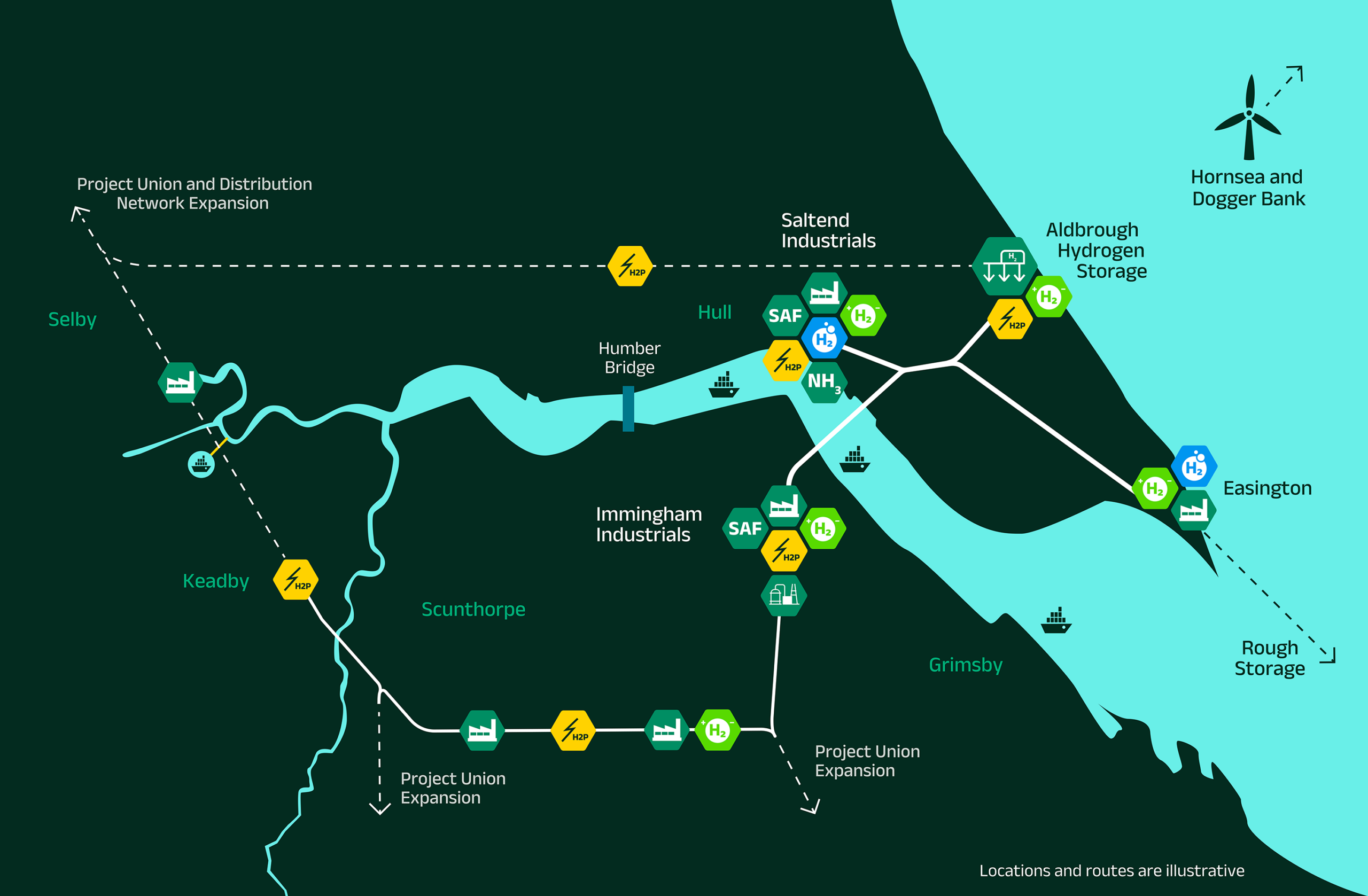
Across key sites at Aldbrough, Easington, Saltend, Immingham, Keadby and beyond – the region is an industrial hub at the heart of the energy transition.

National Gas, Equinor, Centrica, and SSE Thermal are bringing proven delivery experience across the full hydrogen value chain, and a shared commitment to the Humber’s role as Britain’s hydrogen heartland.

To achieve this, the network, through projects Humber Hydrogen Pipeline (HHP) and Aldbrough Hydrogen Storage, will submit proposals under the UK Government’s Hydrogen Transport and Storage Business Model processes  to determine where the first hydrogen network is built. This will establish the future of hydrogen in Great Britain.

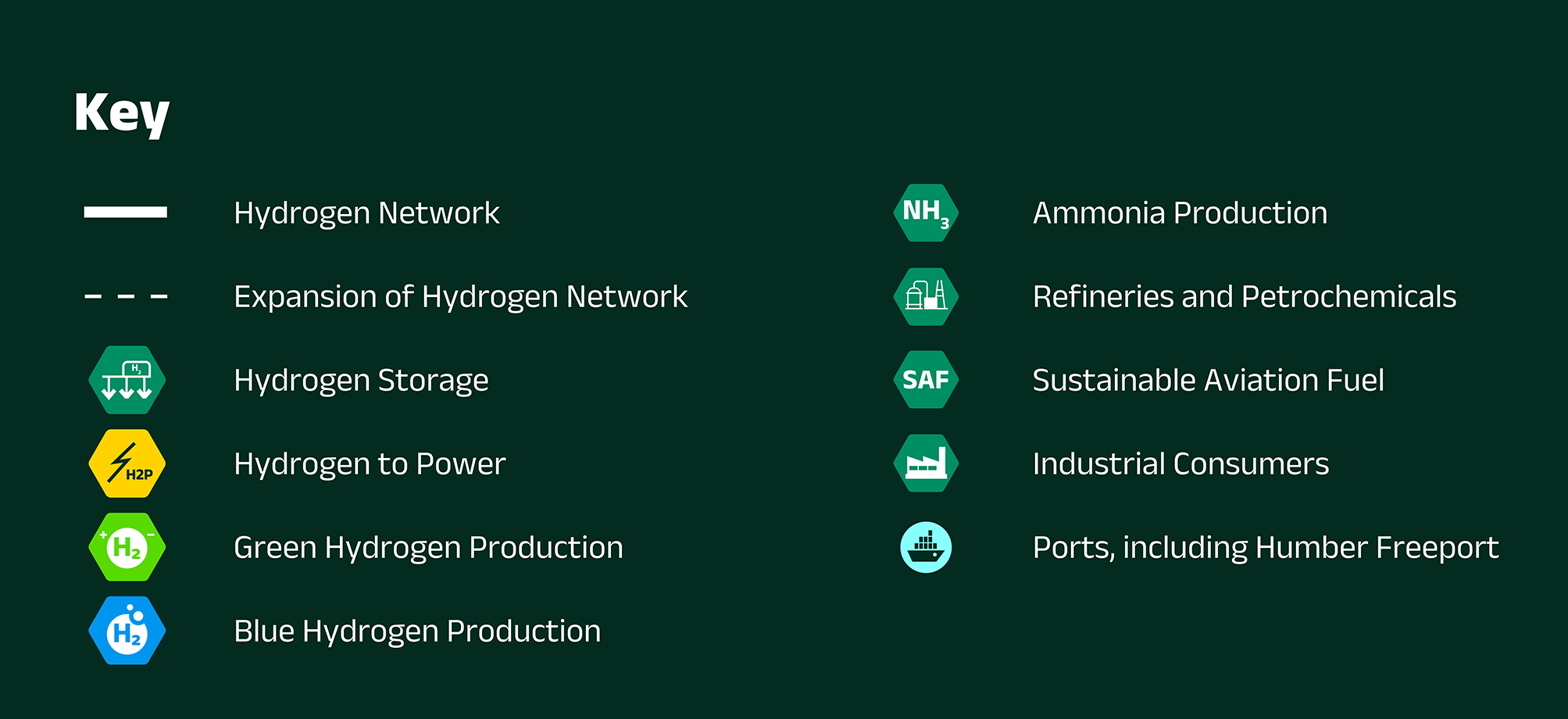
Hydrogen storage, with build-out potential

  • Anchor: Aldbrough Hydrogen Storage
  • Expansion: Rough Hydrogen Storage

Demonstrator-scale hydrogen

  • Aldbrough Hydrogen Pathfinder

Power stations investing in more than 4 GW
of 100% or blended hydrogen

  • Centrica’s Glanford Brigg
  • Keadby Next Generation
  • Keadby II
  • Statera’s Creyke Beck
  • Triton’s Saltend Power Station
  • VPI Immingham

Five projects producing up to 1 GW of green hydrogen

  • H2H Easington Green (Centrica, Equinor)
  • Humber H2Hub®, Immingham (Uniper)
  • Immingham Green Energy Terminal (ABP)
  • Saltend Green Hydrogen Hub (Meld)
  • Singleton Birch (Centrica)

Up to 2 GW of blue hydrogen production

Blue
  • H2H Easington Blue (Centrica, Equinor)
  • H2H Saltend (Equinor)

Extensive, credible, hydrogen demand points, include

Ammonia production

  • Yara Ammonia Facility, Saltend

Refineries, petrochemicals and sustainable aviation fuel (SAF)

  • P66 Sustainable Aviation Fuel, Immingham
  • P66 Humber Refinery, Immingham
  • Humber SAF, Immingham

Other Industry, fuel or offtakers

  • British Steel, Scunthorpe
  • Easington Terminal, Centrica
  • Guardian Glass, Goole
  • Northern Gas Networks
  • Singleton Birch 

The Humber’s industrial landscape

*Industrial Decarbonisation Research and Innovation Centre, Humber Industrial Cluster, LINK

Putting the Humber at the heart of Britain’s hydrogen industry.

Hydrogen has a critical role to play in meeting the UK’s energy needs – from decarbonising hard-to-electrify industries such as steel, glass and cement manufacturing, to providing feedstock for high-value products such as ammonia and Sustainable Aviation Fuel (SAF).

The Humber’s geology, high-value infrastructure and skilled workforce make it the natural choice to lead the UK’s transition to a hydrogen economy.

By creating an integrated network of hydrogen production, transport and storage across East Yorkshire and North Lincolnshire, Humber Hydrogen is supporting the region’s industries to reduce emissions and create jobs – underpinning economic growth and propelling the Humber into a new era of global leadership in low carbon industry.

Up to

3 GW

of blue and green hydrogen could be produced across the Humber.

About Humber Hydrogen

Projects in the network include:

Aldbrough Hydrogen Storage

(Equinor & SSE Thermal)

Development of up to nine new salt caverns adjacent to the existing gas storage site, with an initial capacity up to 420 million m³ providing strategic balancing for hydrogen supply and demand. This is equivalent to the amount of gas in Britain’s entire gas system on a peak day.

Aldbrough Hydrogen Pathfinder
(Equinor & SSE Thermal)

This project tests and demonstrates hydrogen production, storage and power on a single site, to accelerate value chain learning and flexibility.

H2H Easington

(Centrica & Equinor)

A multi stage green and blue hydrogen hub with an ambition of up to 2.2 GW of production through the 2030s, with initial development phases targeted to align with the development of the pipeline and salt cavern storage.

H2H Saltend

(Equinor)

A 600 MW low carbon hydrogen production plant with carbon capture at the Saltend Chemicals Park, driving a 30% reduction in site emissions.

Humber Hydrogen Pipeline 

(Equinor, SSE Thermal & Centrica)

Development of a 54 km underground pipeline linking Easington, Aldbrough and Saltend, with a crossing to the south bank to serve industry.

Keadby Next Generation Power Station

(Equinor & SSE Thermal)

A 900 MW hydrogen-ready power station, to provide flexible, low carbon power as hydrogen supply scales – with initial planning stages already under way.

Project Union: East Coast

(National Gas)

Connecting Teesside and the Humber, this is the first section of Britain’s core hydrogen network to receive Ofgem funding for detailed engineering development.

Humber Hydrogen supporters

Leading industries set to benefit from locating Britain’s first hydrogen transport and storage network in the Humber.

Why hydrogen in the Humber is key to unlocking the future of Britain’s industry

The Humber is the UK’s ‘energy estuary’. Home to pioneering advances such as the landing of the first North Sea gas at Easington in 1967 and one of the country’s oldest chemicals parks at Saltend, the region has become a centre for oil refining, petrochemicals, power generation and offshore wind – all of which play a vital role in the UK economy and the nation’s energy security.

The Humber’s connected geography, natural salt caverns, heavy industrial base and skilled workforce make it the ideal location for the UK’s next step in large-scale hydrogen infrastructure development.

Energy heritage, future focus
The Humber has powered the UK for generations. Nearly six decades on from the birth of the gas era in the Humber, the region is ready to build on its proud heritage and deliver on the energy transition once again, with a highly skilled workforce and established projects developing modern infrastructure at pace.

Geology and infrastructure advantage
The natural salt caverns at Aldbrough can be adapted for safe hydrogen storage, enabling large, flexible capacity while minimising local disruption, supporting a cost‑effective network built at pace.

Plugged into the core national hydrogen network
Our assets are positioned to connect with Project Union, Britain’s planned 1,500‑mile core hydrogen network, now moving into detailed engineering for the East Coast link across Teesside and the Humber with Ofgem support.

Driving growth and decarbonisation
The Humber industrial cluster contributes £18 billion to the economy each year and supports tens of thousands of high-value jobs – but it is also the UK’s most carbon-intensive cluster. By supporting fuel switching for hard-to-electrify sectors and enabling future fuels like SAF and ammonia, Humber Hydrogen will help anchor long term industrial activity, attract investment, and protect skilled jobs.

How Humber Hydrogen
will deliver

Integrated delivery, phased for pace
We’re linking production at Easington and Saltend to storage at Aldbrough and demand across both banks of the Humber via the Humber Hydrogen Pipeline and connections into Project Union as it advances. Our approach gives industry and power generators a flexible, reliable hydrogen supply while the national network scales.

What this means for you

  • Manufacturers & power generators: Firm pathway to low‑carbon hydrogen at scale with storage‑backed flexibility.
  • Communities: Secure jobs, local supply chains, and investment tied to clean growth.
  • UK energy system: A core node for Britain’s hydrogen backbone supporting renewables integration, energy security and industrial decarbonisation.

65

%

of the UK's total potential new-build storage capacity for hydrogen is located in East Yorkshire.*

*Arup, Assessing Regional Demand for Geological Hydrogen Storage, February 2024, LINK

News

The latest updates and announcements from Humber Hydrogen and its partners.

Leading energy companies unite in bid to create Britain’s first hydrogen network in the Humber

Contact

Please fill in the form below to get in touch with us.

All copy and content is copyright © 2026 Humber Hydrogen. All rights reserved.